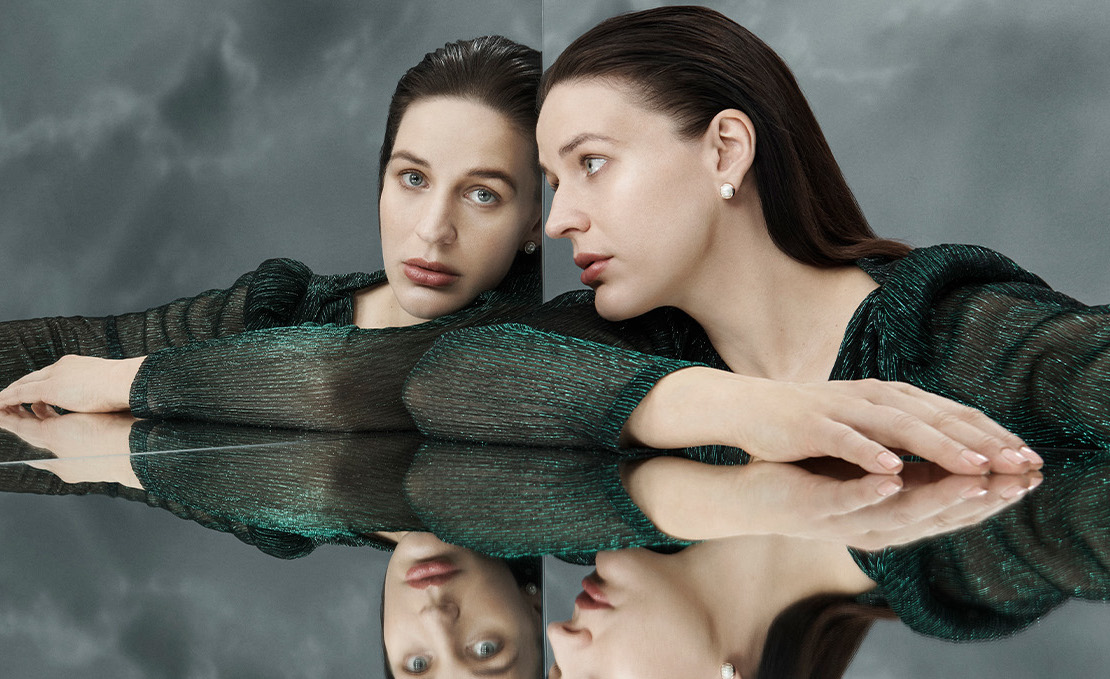
The opening of the second half of the 2025–26 season on March 9 is sure to be a Wagner event for the ages, as blazing soprano Lise Davidsen headlines the composer’s all-consuming epic Tristan und Isolde after years of anticipation. With heroic tenor Michael Spyres as Tristan and Music Director Yannick Nézet-Séguin on the podium, the stage is set for the premiere of a daring new production by director Yuval Sharon, who sees the opera as one transcendent episode in an endless cycle of death and rebirth.
Lilli Lehmann. Kirsten Flagstad. Astrid Varnay. Birgit Nilsson. The names of the superhuman sopranos who owned the role of Isolde in earlier eras at the Met have become synonymous with soaring high notes, thunderous power, and endless reserves of volcanic sound. This season, the company is poised to add another name to this list of legends.
Since making her Met debut in 2019, Norwegian soprano Lise Davidsen has showcased a golden-age Wagnerian voice, giving unforgettable portrayals of Chrysothemis in Elektra, Leonora in La Forza del Destino, Eva in Die Meistersinger von Nürnberg, and the title characters of Ariadne auf Naxos, Tosca, and Fidelio, among others. Now, she strikes at the heart of the dramatic-soprano repertoire as the proud Irish princess Isolde, a role she seems born to sing. Powerhouse tenor Michael Spyres makes a major role debut as Tristan, completing the couple whose enmity transforms to insatiable and self-annihilating passion thanks to a potent love potion. Met Music Director Yannick Nézet-Séguin takes the podium to conduct one of the most important scores in all of music and lead the remarkable cast, which also features mezzo-soprano Ekaterina Gubanova as Brangäne, bass-baritone Tomasz Konieczny as Kurwenal, and bass-baritone Ryan Speedo Green as King Marke.
The Met’s new Tristan und Isolde also marks the company debut of one of today’s most innovative and in-demand theatrical minds. Hailed as “the most visionary opera director of his generation” by The New York Times, Yuval Sharon arrives at the Met having made a name for himself with his inventive approach to stagecraft, which has resulted in a one-hour adaptation of Wagner’s Götterdämmerung in a parking garage, a site-specific world premiere amid the bustle of Los Angeles’s Union Station, and Puccini’s ever-popular La Bohème presented in reverse. His productions have won raves across Europe—including at the famed Wagner festival in Bayreuth, where he was the first American ever to direct a production—and as artistic director of Detroit Opera, he has overseen the company’s transformation into a leader on the American operatic scene.
Preparing to direct Wagner’s towering masterpiece, Sharon—who will also helm the company’s new Ring cycle in future seasons—discussed his deep affinity for the composer’s work, the timelessness of Tristan und Isolde, and navigating the space between this world and the next.
You’ve been called “opera’s disrupter in residence.” Do you feel that’s a fair representation?
It’s a fun title, but I don’t necessarily approach a project thinking I need to break something for the sake of making something different. I believe in opera’s power to connect with an audience, but I also think the best operas ask their audiences to be courageous and experience something they never have before. Tristan und Isolde still sounds so modern today, I can’t even begin to imagine how audiences in 1865 made sense of the world premiere. And I feel my responsibility as the director is to find new ways of making Wagner’s original audacity visible to a contemporary audience. That means constantly questioning how the opera lives on stage—in the interaction between performers and in the visible dimensions of the production’s design world—and that often leads me and my team into wondrous and unexpected discoveries. I think that sense of awe was precisely what motivated Wagner as well.
How would you describe your relationship with Wagner’s work?
The second opera I ever saw was Siegfried, and that might seem like a hard sell to a 13 year old who was much more into Star Wars than anything resembling opera. But even as a kid, something about Wagner’s vision of a total work of art found a way to stir my curiosity as an audience member with almost no experience of the art form. I never imagined then that I would dedicate so much of my life to realizing his works on stages around the world, including at his own theater, Bayreuth, and soon on the incredible stage of the Metropolitan Opera. Although different aspects of Wagner’s operas fascinate me now that I’m in my 40s, I find it astonishing that the same work can simultaneously speak to people of different generations and across different centuries. As I prepare productions of Wagner operas now, I keep in mind the 13 year olds in the audience that may be having their very first encounter with opera. They deserve access to that overabundance of imagination that makes Wagner so compelling to those of us who fell in love with his works.
Tristan und Isolde is a work that has been endlessly analyzed and discussed since its premiere 160 years ago—and one that can be interpreted in countless ways. What particular aspects of the opera do you hope to explore in this production?
Tristan und Isolde is often called, rather gloomily, “a song of love and death,” but I think this has misled audiences for generations.This opera is less interested in the finality of death than the ecstatic mystery of rebirth. The entire piece is a ritual encounter that leads toward Act III, in which Wagner shows us two ways to face death: We see Tristan dying slowly and in agony, terrified, disoriented, clinging to his ego and suspecting that his life has been a meaningless string of suffering. And then we have Isolde, who dies rapturously, willingly, and completely letting go. Her final aria has become known as the “Liebestod,” or “love-death,” but Wagner instead described her final moment as a transfiguration, which I think is so much more appropriate. Replacing the linear notion of death with the cyclical idea of rebirth is at the heart of our production.
Can you elaborate?
The poetry of Tristan revolves around images of polarity: day and night, male and female, life and death. Those images are at the core of both the text and the music. Right from the very first measures of the prelude, Wagner famously overlaps two separate musical ideas on top of each other. The result is an unresolved chord, the “Tristan chord,” that holds in miniature the tragedy of the entire opera: two forces that are close together but won’t unite, as desperately as they try. In that gap, in that search for resolution, is the longing for union—in the libretto you will hear the word “Sehnen,” which Tristan and Isolde feel as a romantic, erotic, and mystical drive towards each other. If union is the true nature of reality, then that polarity is a delusion they are desperate to overcome. I was looking for a way to visualize these tragic oppositions on stage, as well as the notion that there is another reality underneath the world of binary logic.
How will you represent this on stage?
To explore polarity, we are introducing a “split world” into our production: Let’s call it the “world of the table” and the “world of the fable.” At the start of the opera, the singers will appear on the stage in a way that will feel very recognizable to us in 2026, closer to a contemporary couple. At the table, arranged ritualistically, are all the objects that have the totemic power to bring us into the world of Tristan and Isolde’s story. As the music unfolds, those objects become portals into another dimension, containing the landscapes of the opera: The water in the jug becomes the ocean centuries earlier, as Tristan’s ship carries Isolde to King Marke. The couple at the table become possessed with the music and the story, occupying both worlds at once: our world, from the standpoint of 2026, and the mythic world of the opera, existing in the blurred historical moment of legend. Like shamans, they will stand in the visionary space containing two realms. And this, I think, is the herculean task given to the singers of this opera as they take on the enormous roles that Wagner wrote for them. They bravely become vessels for the enormous emotional and psychological experience of the audience, even as they remain two fragile individuals, Lise Davidsen and Michael Spyres. The first tenor who performed Tristan died shortly after the first performances, and everyone blamed Wagner for writing such a strenuous role. I want the audience to understand how dangerous this work really is, and to realize how grateful we are that Lise and Michael are brave enough to take us to the depths and the heights that this score demands of them.
Your set designer, Es Devlin, has received acclaim for her work across opera, theater, concerts, and art installations. Tell me a little about her scenery for the production.
To visually frame the opera as a kind of ritual of death and rebirth, Es has created a tunnel that represents potential death—like when people who have near-death experiences talk about going toward a light at the end of a tunnel. But it could also be a tunnel to a new birth. In Act II, Tristan’s mysterious answer to King Marke’s devastating monologue is to imagine death as a return to the womb. We don’t fully reach the tunnel until Act III, as Tristan lingers between life and death, but in the previous acts, we use elements from the tunnel in bits and pieces to create the settings for the other scenes. The entire set will also act as a giant canvas for projections.
So it’s safe to say that video also plays a major role in the production?
Yes. Ruth Hogben is an incredible filmmaker who can take everyday objects and make you look at them in ways that you’ve never considered before. Together with my frequent collaborator Jason Thompson, we are going to use video to magnify the ritualistic objects and create the illusion that they contain a whole universe. For example, in the climactic scene of Act I, Isolde confronts Tristan about the moment she had his life in her hands: She held his sword up to his neck, and through an unexpected swell of emotion, she dropped the sword and let him live. In our production, the Isolde sitting at the table will pick up a knife and hold it to the neck of the more contemporary Tristan sitting across from her. We see a glinting knife projected onto the stage, and then the set opens up, containing the mythic Tristan and Isolde within that knife. The entirety of their history lives in the gleam of that knife. Then, at the start of the second act, Isolde will light a candle at the table. Through video and projections, it will seem as if Brangäne’s voice is coming from inside the light of the candle: the nagging, persistent voice of caution that Isolde snuffs out before she abandons herself to her lover, even as she knows it will bring about their own destruction.
What do you hope audiences take away from this production?
A fundamental aspect of how I think about opera is that there are as many potential takeaways as there are audience members. I want to offer an interconnected web of narrative ideas, visual ideas, and conceptual ideas as a kind of forest for the audience to wander through and make the piece their own. Tristan und Isolde is probably the single hardest opera in the entire repertoire. It’s hard for the singers, who have to sing these enormous roles. It’s hard for the conductor and the orchestra, who go through such an endurance test playing this extraordinary score. And it’s hard for me as a director, as I try to find a theatrical language to convey everything Wagner is saying in this complex musical and dramatic text. The only people it’s not hard for are the audience. They get to go on a transformational ride into the unknown realms of ocean, cosmos, and self. So I hope they will let the vortex pull them in, and that they will wander through this forest with us.
Interview by Matt Dobkin
An Opera Against Life
Tristan und Isolde at The Met
Garth Greenwell (Mar 27, 2026)
It really does end with the most beautiful music anybody has ever written. If you’ve heard anything from Tristan und Isolde, and you probably have, the Liebestod, when Isolde sinks ecstatically down upon the body of her lover, is what you’ve heard. Either the Liebestod or the opera’s Vorspiel, the orchestral introduction—and it makes sense that these are the two most famous bits, since even though five hours separate the opera’s first music from its last, a straight line runs from first note to final silence. People like to quote T.S. Eliot when they talk about this aspect of Tristan, especially from Four Quartets. In the program note to the Met’s new production, the director Yuval Sharon offers “all is always now”; for Leonard Bernstein it was “in my end is my beginning.”
Bernstein shows what he means in his famous lecture on Tristan, which is maybe the most brilliant fifteen minutes of accessible, profound musical demonstration I know. Here’s the basic idea: the opera begins with the most famous chord in classical music, the “Tristan chord.” No one has been able to analyze this in anything like a satisfying or definitive way; the Grove Dictionary of Music, a standard reference work, offers two different accounts of it. This is the point, and Bernstein uses it as the centerpiece of a lecture on musical ambiguity. It consists of two tritones (the diabolus in musica, the devil’s interval), two dissonances, laid on top of each other. [EDIT: As a few people have pointed out on social media, this is not right! There’s only one tritone in the vertical harmony, with a second appearing (fleetingly) later in the measure. Sorry! But the point about cascading dissonances resolving to further dissonances stands.] A dissonance is an unstable thing, it wants to move: when you hear it, you long for it to resolve to a consonance. Wagner’s dissonances do resolve, but only ever one at a time, which means that his dissonances resolve to new dissonances. For centuries, functional harmony had resulted in music of motion and rest; in Tristan, Wagner invented a music that never rests.
People often talk about the opera as “the liberation of dissonance,” and it represents a turning point in western music. It’s not that it was entirely new: Bernstein is brilliant in showing how Wagner adapts motifs from Berlioz, and much has been written about his harmonic debt to Liszt. But Wagner took things to new extremes, as was generally true about him; he made one of the few works of which it can be said that it is radically new, in the sense that it opened pathways other artists would explore for decades. Every composer after him had to be for or against Wagner and what he represented, and that allegiance or defiance determined much of the shape of their work. We still haven’t assimilated Tristan—maybe it’s unassimilable, and maybe that’s a measure of its achievement. It still sounds radical; it’s still challenging. I’m not sure I can think of another work that combines such immediate, sensuous pleasure with such provocation. More than a century and a half after its premiere, it’s still hard to know how to hear this music, how to understand it.
In music, in western culture more generally, there is before and after Wagner. It’s deeply unfortunate that he was such a genius, really one of the greats, since (unlike Ruth Asawa, say) he exemplifies all the very worst baggage that term carries. He was overbearing, unbearable, a narcissist like no other, obsessed with his own suffering, fully convinced of his brilliance and that it licensed the very worst behavior. He knew he wasn’t like other people and didn’t understand why he should be expected to follow their rules. Oh, and while it’s hard to draw a direct line, as some have tried, from Wagner to the Nazis, he was without question a vicious antisemite, and not of the kind you might imagine defending (as people sometimes defend T.S. Eliot) as in line with the views of his time. Wagner’s 1850 article “Jewishness in Music,” first published pseudonymously, sparked disgust in his own time, including among his friends. And it’s not like he outgrew his prejudices; he republished it under his own name in 1869.
It’s extremely easy to dismiss Wagner, so long as you’re not listening to the music. But tune in to the Liebestod and all the foolishness falls away; what’s left is an absolute of beauty. I have plenty of mixed feelings about Lise Davidsen’s much-hyped Isolde, though I do think she’s remarkable; but that ambivalence fell away too in her genuinely exquisite, radiant singing in the opera’s last minutes. I’ve never heard the Liebestod sung so beautifully in a live performance. It’s really unimaginable: how can she sound so fresh-voiced after five hours of singing? She sounds as if she could turn around, after her gorgeously floated final note—on Lust, which here is probably best translated “rapture,” a piano F# at the top of the staff, approached via octave leap (this is really hard)—and sing the whole opera again, maybe twice over. I felt this in the house, where Davidsen’s piano singing, even in the Liebestod, was sometimes covered by the orchestra, unconscionably and by no fault of her own; and I felt it in the broadcast, where you could hear every note. A thought I had many times watching the same performance at the Times Square AMC on Wednesday: What a difference a mixing board makes!
But there’s more to the Liebestod than the last note. The primary source of my ambivalence about Lise Davidsen, whom I’ve heard live several times now, including in recital at the Met, is what seems to me her difficulty in singing real lines. (She’s doing a Schubert recital at Carnegie Hall in June that I take as a good sign of her artistic ambitions and that I will be very sad to miss.) I thought about this a lot in both viewings of the performance. There’s no question that she has an instrument that really is a marvel, a best-in-class, once-in-a-century phenomenon; even the great dramatic sopranos of the past hundred years—like Birgit Nilsson, for example, who’s often mentioned as Davidsen’s peer—don’t compare with Davidsen’s voice above the staff in its combination of power and beauty. Nilsson’s high notes, at least as they’re captured on recordings, were thrilling, they shot out like laser beams; but they weren’t beautiful. My favorite Isolde, with whom Lise Davidsen can’t compare, at least not yet, for musicality or profundity, is Waltraud Meier; but she doesn’t have anything like Davidsen’s freedom above the staff, or her power in any range. (Meier’s virtues are to my mind more important than these.) Lise Davidsen’s high notes don’t just shoot out like Nilsson’s; they irradiate. They’re not laser beams but floods of light.
[
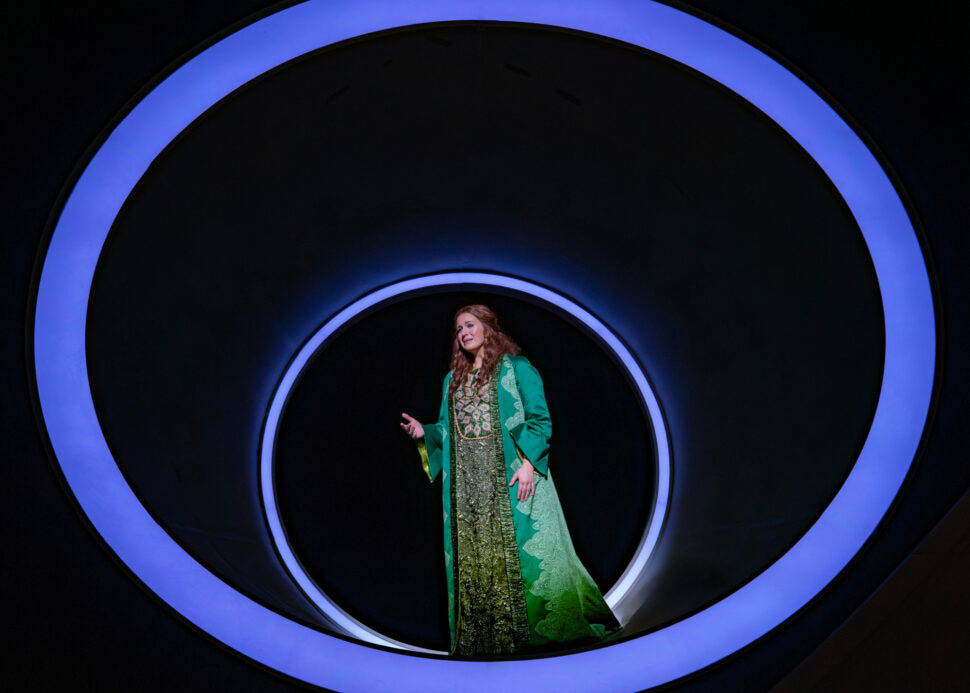
Lise Davidsen as Isolde
But having high notes that sound like daybreak over the Alps is one thing; being a singing artist is another. The voice is not uniformly brilliant; the lower register is weak (something I thought about on the evening before the Live in HD screening, watching Lisette Oropesa, a soprano of an entirely different type, bring her thrilling chest voice to Violetta); the middle register sometimes wobbles. I’ve said before about Davidsen that the voice sometimes feels like multiple instruments: her extremely covered, dark lower and middle registers can seem like a completely different voice from the radiant top. But the real problem is that too often I feel that Davidsen is singing at the level of the note: that each note is shaped, often beautifully, but that they don’t congeal into a higher unit, into a line. Line, by which I really just mean a shaped movement of energy, is always a problem in art, at once the most simple thing and the deepest mystery.
What does it mean to turn a sequence of notes into a line? It’s not something you can answer empirically, exactly: it’s not just a question of note values or dynamics. I kept thinking about two things as I listened to Davidsen’s Act I Isolde. One was a moment from Alexander Chee’s debut novel, Edinburgh, which I’ve just been rereading, where an art teacher tries to show the narrator something about lines: “He would point at drawings and say of the lines, Do you see, this is another language from this, they are not talking to each other.” I felt that way about Davidsen’s notes: too often, they don’t speak to each other; it’s as though one note hasn’t heard yet what the next is planning to do. It’s somehow a question of intelligence, by which I don’t mean Davidsen’s intelligence but the notes’: the way they share information, the way in a great performance the quality of the first note of a phrase is preparing for and determined by the last.
This is genuinely hard to think about, much less achieve—and it’s a question that comes up in fiction, too. The other thing I kept thinking about at the opera was Paul Ricoeur’s notion of emplotment, which is how he tries to address the same question slightly reframed: how can a series of discrete events be turned into a story? Ricoeur, with his thoughts about habitable time, is a good companion for Tristan, which is so much about the non-habitability of time, about wanting break free from it. (Ewig, forever, is a key word in the lovers’ second act duet, where they long to become ewig ein, forever one. “Tristan du, ich Isolde,” Tristan cries queerly in ecstasy; Isolde, mutatis mutandis, echoes him.) One way of thinking about an answer is intentionality, understanding events not objectively like a chronicler but in their human meanings, their meanings for someone or someones. Something similar happens in a musical line when each note is energized by its relation to the others—a relation that I suspect different singers achieve differently: some might think of it primarily in terms of the music, others in terms of drama. Lise Davidsen’s singing too often feels to me like individual notes, often beautiful, but uncongealed by emplotment.
As I say, I’ve long felt ambivalent about Davidsen’s singing, and that was true through much of Act I. But in the two moments of Tristan where it is most important she did sing lines, and beautiful ones. One of these is the Liebestod, which is all about long, swelling, pelagic lines, and in which—as with that last floated Lust—the line needs to be intelligible across leaps as large as an octave. The Liebestod doesn’t have stratospherically high notes—one of the amazements of the music is that Wagner dramatizes an extreme of ecstasy without ever going above an A-flat (or G#, its enharmonic equivalent). It does have several of those, and it is superhuman to have the endurance, after a full night of singing, to sing above the staff quietly, as Davidsen did, and while shaping such beautiful phrases. One example: after the first big swell on “wie er leuchtet” (“how he glows”), which rises up to the aria’s first A-flat, followed almost immediately by another, the music pulls back. It does this, as it will again, by asking a question: “Seht ihr’s nicht?” (“Don’t you see it?”)

Here came the moment that took my breath away, on the phrase—well, really it’s two phrases that have to be joined into one. First: “Wie das Herz ihm mutig schwillt” (“How his heart swells with courage”), which restates the aria’s opening gesture, a rising fourth, now transposed up a tritone (and so recalling that opening chord). The two-syllables of “mutig,” brave, require a leap from B-natural on the stressed syllable to G above the staff on the unstressed syllable. This is hard! The soprano needs to float up, as if it were effortless, before descending two semitones on “schwillt.” How perfectly Davidsen did this, while keeping exact pitch; the line just melted away. But not entirely! Because the second phrase (or the second half of this phrase) picks it up, beginning another half-step down, on E natural (for “voll”), before dropping down a fifth to an A natural, then rising a major sixth to an F-sharp on “hehr.” Lots of sopranos punch that F-sharp, which makes it easier to sing, but Davidsen kept it in line with “mutig schwillt,” a change of degree but not of kind; she floated the “hehr” in a bell-like mezzopiano. It was just breathtaking, spectacularly controlled—and typical of Davidsen’s singing of the aria as a whole. Her pitch, which very occasionally faltered earlier in the evening, was extremely good in the Liebestod; every semitone was clear.
As I say, it was the most beautiful Liebestod I’ve heard as part of a live, full performance. It didn’t, for me, displace Jessye Norman’s Liebestod, which is just an ideal of beauty, one of the points of my aesthetic compass—but Norman sang the Liebestod as a concert aria, not in staged performances: she treated it as art song, not as the end of a drama. (Much less of five hours of singing.) For drama and musicality, Davidsen also doesn’t displace my favorite Isolde, Waltraud Meier, in the extraordinary Patrice Chéreau production conducted by Daniel Barenboim. Watching this (it’s on YouTube) is a great way to experience the opera, especially for the first time. Chéreau finds a way to make Tristan work as theater—a challenge for a narrative that combines 19th-century operatic foolishness (witches and magic potions) with an unprecedented psychological profundity. Meier’s voice is not at its peak, though it’s still remarkably beautiful, and by the Liebestod she sounds tired; but she has such radiant intelligence, such intensity, such musicality—none of which Davidsen can match, at least not yet. The whole performance is one of the great things I know.
Waltraud Meier as Isolde in Patrice Chéreau’s production, La Scala 2007
The other musical moment that especially depends on sustained, controlled lines is the love duet that makes up much of Act II, and here too Davidsen was marvelous. In general she was terrific when interacting with Michael Spyres, the evening’s Tristan and for me the production’s real revelation. I’ve long been skeptical of Spyres, even more so than of Davidsen. I didn’t love him in Idomeneo a couple of seasons ago, and liked him even less in Norma. Well, I take it all back. He was extraordinary in Tristan, even though he suffered most from both the production (which often placed the singers far back on the set) and the insensitive conducting. He was too often covered in the house—I admired him very much for not pushing, for protecting his instrument; I was grateful to the broadcast for letting me hear every note.

Spyres’s baritone timbre serves Tristan well, and his phrases were as taut, as intelligently alive, as Davidsen’s were (too often) slack. In the score’s spare textures, as at the beginning of the Act II duet, he brought out a lyricism in Tristan I’m not sure I’ve heard before. There are some very painful performances of Tristan on record; Wagner chews through voices, especially tenor voices; even some of the legendary names, like Wolfgang Windgassen, seldom sound beautiful in the role. Jon Vickers was capable of beautiful singing in the role but often for some reason chose ugliness. (He was an infamous homophobe; maybe he thought singing it beautifully would be gay.) I like Siegfried Jerusalem’s Tristan a lot, but he doesn’t have the beauty of tone that Spyres brought to his performance. Never has Tristan sounded to me so young, so poetic, so much a lover; and one sensed that Spyres brought out the best in Davidsen, too. They really sang together in their duet, one felt they were listening to each other, responding to each other; they weren’t just two soloists singing side by side.
But the real marvel came in Act III. This is Tristan’s big moment, an extended two person scene with Kurwenal, his loyal subordinate. (I’m sorry that I don’t have anything good to say about the singing of Polish baritone Tomasz Konieczny, whose sound was the most generically Wagnerian, in the derogatory sense, of the production: he shouted and barked in a kind of sustained pitched grunting.) (I also don’t have anything good to say about the Brangäne of Ekaterina Gubanova, except that she was hugely endearing in her first-intermission broadcast interview.) Much of the scene is really a monologue, as Tristan, mortally wounded and desperate for Isolde, drifts in and out of consciousness, alternating between dazed bewilderment and ecstatic anticipation. It’s a kind of mad scene, really, though I guess it isn’t so much madness that claims Tristan as a vision of true reality, the noumenal realm of Schopenhauer’s philosophy, which Wagner imported more or less wholesale into the opera. Spyres sang much of this with a very pure tone, brighter than his usually hooded sound; it made him sound like someone who really had passed through a different realm, received a vision that separated him from normal life. He managed effects I’ve never heard in the scene before, as when, singing the phrase “göttlich ew’ges Urvergessen” (“divine, eternal, original oblivion”), which rises stepwise from A-flat to D, Spyres pulled beautifully back on the ascent, arriving at “Urvergessen,” which is accompanied by a really uncanny harmonic effect, a sudden D major triad, with a gorgeous piano tone, a kind of hallowed sound.
Really I feel like you could marvel at almost any of his phrases; he brought a musical intelligence to the role that seems to me very nearly unmatched. Spyres and Davidsen are both at the very beginning of their interpretations of these roles; for Spyres the Met production is his role debut. (Davidsen has sung Isolde once before, earlier this year in Barcelona.) I wasn’t convinced at the end of the night that Davidsen is an Isolde for the ages, though I hope she will become one. But Spyres seems to me already on par with the great Tristans in recorded opera. I’m sorry I’ve taken so long to hear how good he is; it was clear to many of my friends much earlier. Hearing his Act III of Tristan filled me with the hope that he will tackle Peter Grimes soon. If anyone at the Met is reading this, please make it happen; I think he would be extraordinary.
The other really great thing in Tristan is the end of Act II, when King Marke, Isolde’s husband and Tristan’s great patron and friend, discovers their betrayal. Wagner wrote music of profound sadness and disenchantment for this scene; it’s pervaded by a bleak sense of devastation. My favorite portrayal is by the great Finnish bass Matti Salminen in the Barenboim / Chéreau production. At the Met, Ryan Speedo Green sounded marvelous in the hall, though I think he suffered most from the Live in HD broadcast. The tone seemed wobblier and less full than it had sounded live; some voices need the spaciousness of a big hall. But even in the broadcast his musicality and dramatic effectiveness were clear.
The musical values of the orchestra were quite mixed. I have never heard Nézet-Seguin give an inspired performance, and his Tristan felt to me weirdly ersatz. There were big dramatic gestures but I felt throughout the night that real intensity was being simulated by dynamics and tempi that were hollow, inauthentic, that gave no real sense of yearning. It was like the music had been passed through an Instagram filter; it had that feeling of eye-catching inorganicness. The woodwinds played well, and the brass were only occasionally distracting; but the strings, which at the Met are usually pretty reliable, were strangely lackluster. Speaking of lines, there’s a lot of very exposed melodic writing for the strings in Tristan, a lot of tutti playing with very little margin for error; if the ensemble is even slightly off things sound smudged. They sounded smudged on Saturday afternoon, sometimes painfully so.
But the real fault was the lack of intensity. Three examples to stand in for a general malaise. There was the opening, which felt just half-a-heartbeat too slow, though really tempo wasn’t the issue—great performances of the opera happen at all sorts of speeds. (Compare Bernstein’s spaciousness with Boulez’s brilliant haste.) What was missing was a kind of tautness in the strings, a sense of urgency or searching. At the opening of the Act II love duet, one of the score’s loveliest moments, the pulsing chords in the strings were similarly lackluster. And then there was the opening of Act III, which starts with gestures in the strings that should be stark and heartrending, that should throw you back in your seat—or just straight into the abyss; it’s one of the great representations of despair I know. Have those gestures ever sounded so polite? Where was the bite, I wondered; why did everything sound so demure? Demure without being careful: I really do think the way throughout the show Nézet-Seguin drowned out the singers was unforgivable.
Also unforgivable, alas, was the production—though this was the element most improved by the broadcast. Clearly the production was conceived for the cinema. Viewed from the house (I sat, as I always do, in the first row of the balcony), the first two acts were theatrically disastrous. Everything seemed motivated by a fear of losing the audience, a sense that we needed constant stimulation, mostly in the form of excruciating projections. I’ve mouthed off about the Met’s projections in this space before; this Tristan reached new lows. It wasn’t just that we were distracted at every moment; it was that everything was so cliché and looked so bad. Generic sunsets and waves, sand running through an hourglass, Disney-villain goblets of poison. Come on! Slightly better were the projections of the singers’ blown-up faces, which at least I was interested to watch, though there’s something a little sad about the Met imitating Taylor Swift concert-style jumbotrons. Are we really just giving up on having a culture?

But the problems went deeper than this. The set consisted of a huge tunnel made of multiple moveable rings, its mouth a complicated set of apertures; it looked like something out of Professor X’s mansion in X-Men. This is one way to deal with the cavernous space of the Met when presenting an opera as intimate as Tristan; but it mistook intimacy for scoured, antiseptic spaces, hostile to human drama. Caught in their little rings, the singers could only stand and sing—precisely the kind of performance Wagner hated. Their “acting” was reduced to the most hackneyed operatic gesticulating. Terrible! It’s true that Tristan is a remarkably abstract opera, and also true that its narrative is fascinatingly interior; it’s almost Jamesian in the way it displaces external action by psychological narration. I’m not at all a partisan for naturalistic presentations. But before Tristan is an opera about ideas it’s an opera about passions, about lived human feeling. Yuval Sharon’s production made that kind of feeling almost impossible to generate or access.
Why are they floating in neon eggs?
This was especially grievous in the love duet, for much of which Tristan and Isolde were in separate spheres, neon eggs that floated past each other. What possible justification could there be for this? They may be singing a Schopenhauerian dialogue about night- and day-time worlds, the noumenal and the phenomenal; they’re also having literal, human, corporeal sex. Hard to imagine as they stood and drifted past each other, singing out into the house. Just a disaster for the show, I thought; but a disaster that the telecast, in which close-ups made the little rings fill the screen, largely obscured. In the cavernous space of the house the result was the opposite of the values—immediacy, humanity, life—Sharon espouses when he talks about his vision of opera. It made the drama seem alien, isolated, cold.
The only glimmer of interest came in Act III, when there did seem to be a rationale for the separate spaces, with the stage representing the daylight, phenomenal world, and the tunnel the noumenal realm of death. Tristan moved back and forth in a way that didn’t work, exactly, but was interesting. An element of the production I haven’t mentioned were the two sets of doubles for the singers, shadow Tristans and Isoldes who often occupied the front of the stage while the singers were relegated to the tunnel. Sharon explains his rationale for this in program note, detailing how the production is structured around three “ritual actions” involving tables (a toast, a banquet, and death / childbearing.) Which, okay. You can read it if you want; I wasn’t convinced. The first appearance of the doubles came in the opening pantomime, where it was honestly a little offensive, the singers literally replaced by thinner, more attractive, made-for-TV actors. (Opening pantomimes, however inexplicable or inert, seem to be de rigueur in new productions at the Met—La Traviata, I Puritani, Tristan all have them—I guess because audiences can’t be expected to listen to music without something inane occupying the visual field.)
But in the third act, Spyres and his double switched back and forth with something like a purpose, as Tristan drifted between life and death. The other effective choice Sharon made, though it’s narratively chaotic, was making Isolde pregnant in the third act; she dies while giving birth to a child. Now there are lots of reasons to object to this. For one thing, it makes no sense. Time is a little vague in the opera, but Tristan has been suffering with a mortal wound; surely he hasn’t been hanging on for months while Isolde (who wasn’t far enough along to be showing in Act II) gestated a baby Tristan. Moreover, the whole point of the end of the opera, the key to the extraordinary character of the Liebestod, which is at once ecstatic and profoundly tranquil, is an end to the suffering of desire, yearning, striving—a suffering that Wagner, following Schopenhauer, believed could only end with death. Part of the great challenging force of Tristan und Isolde is that its profound and devastating, its rapturous beauty is not on the side of life. Sharon’s intervention is a profound betrayal of this aspect of the opera, a profound coopting of its radical vision, sabotaging its least assimilable elements to make it more palatable for the Met’s telecast audiences.
I’m convinced by all those arguments; but also, just on my pulses, I was deeply moved by the choice. Part of the reason may be that Lise Davidsen is a herself a new mother, and has spoken about her difficulties returning to the stage after giving birth; I wondered if the sublime beauty of her Liebestod had something to do with her own new relationship to motherhood. As she cradled her belly it felt as though she was singing as much to her child as to Tristan, and it’s true I am absolutely a sap but I fell for it, 100%. It also, while creating new narrative problems, solves an age-old one: it explains Isolde’s death at the end of the opera, which is otherwise without any explanation beyond grief. It also kind of beautifully wires into the opera’s backstory, which Tristan has reminded us of in the third act: his mother died giving birth to him, a fact commemorated in his name, with its echo of tristesse. He has always had one foot in the realm of death. The opera is supposed to sink to an ending, not suggest a rebirth; but as King Marke took the baby from Isolde’s companion Brangäne and cradled it in his arms, it felt to me like the production’s single inspired choice.
There’s much more to say, about the production (the lighting and set designers should go right with Yuval to jail, only the costume designer and the choreographer go free) and the performances, not to mention the opera itself. I’m looking forward to talking about all of it with a bunch of you on Saturday. (Tomorrow!)